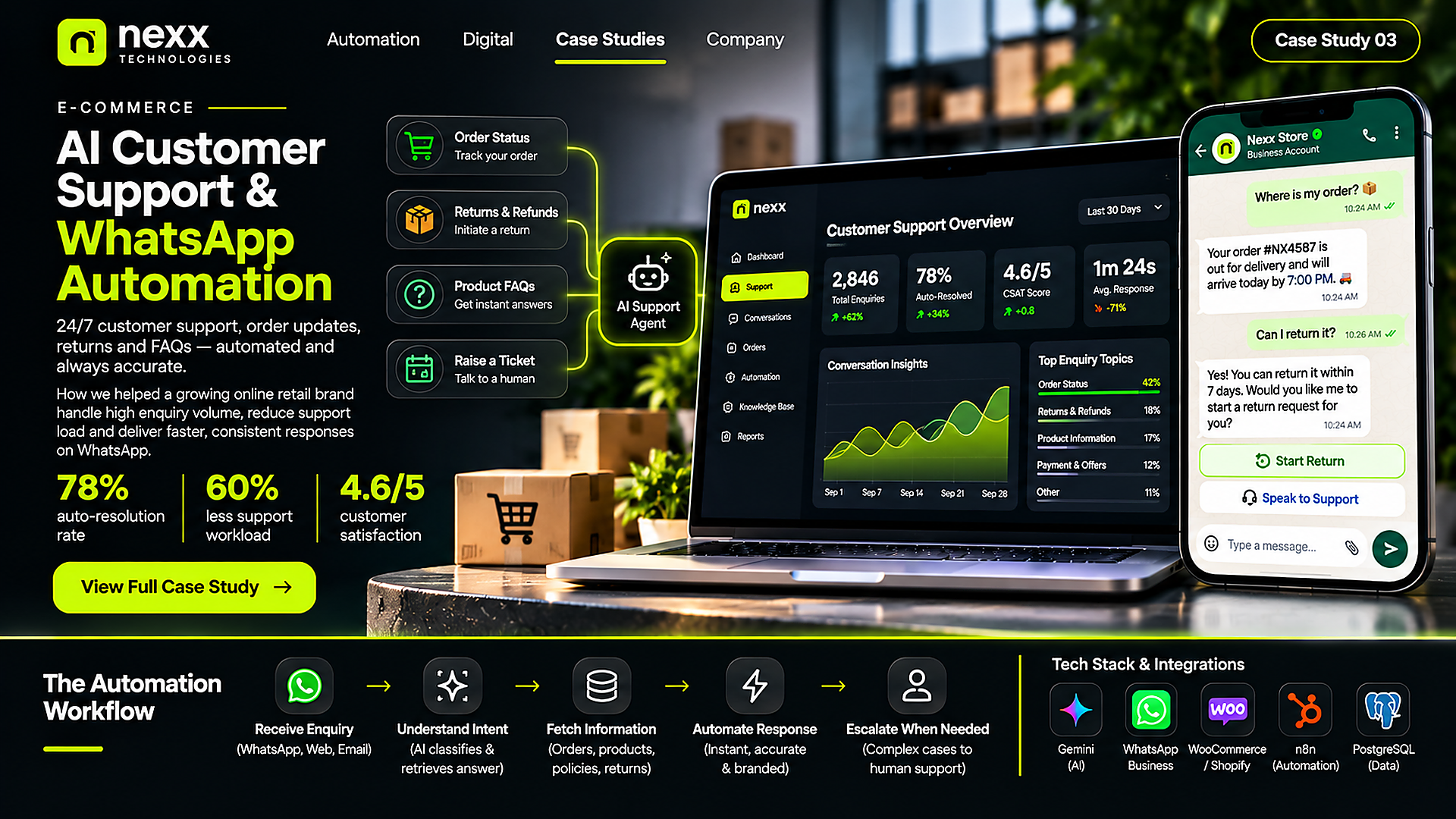
2.5-Day Reporting Lag
Executive team received weekly sales numbers 60 hours after week-end.
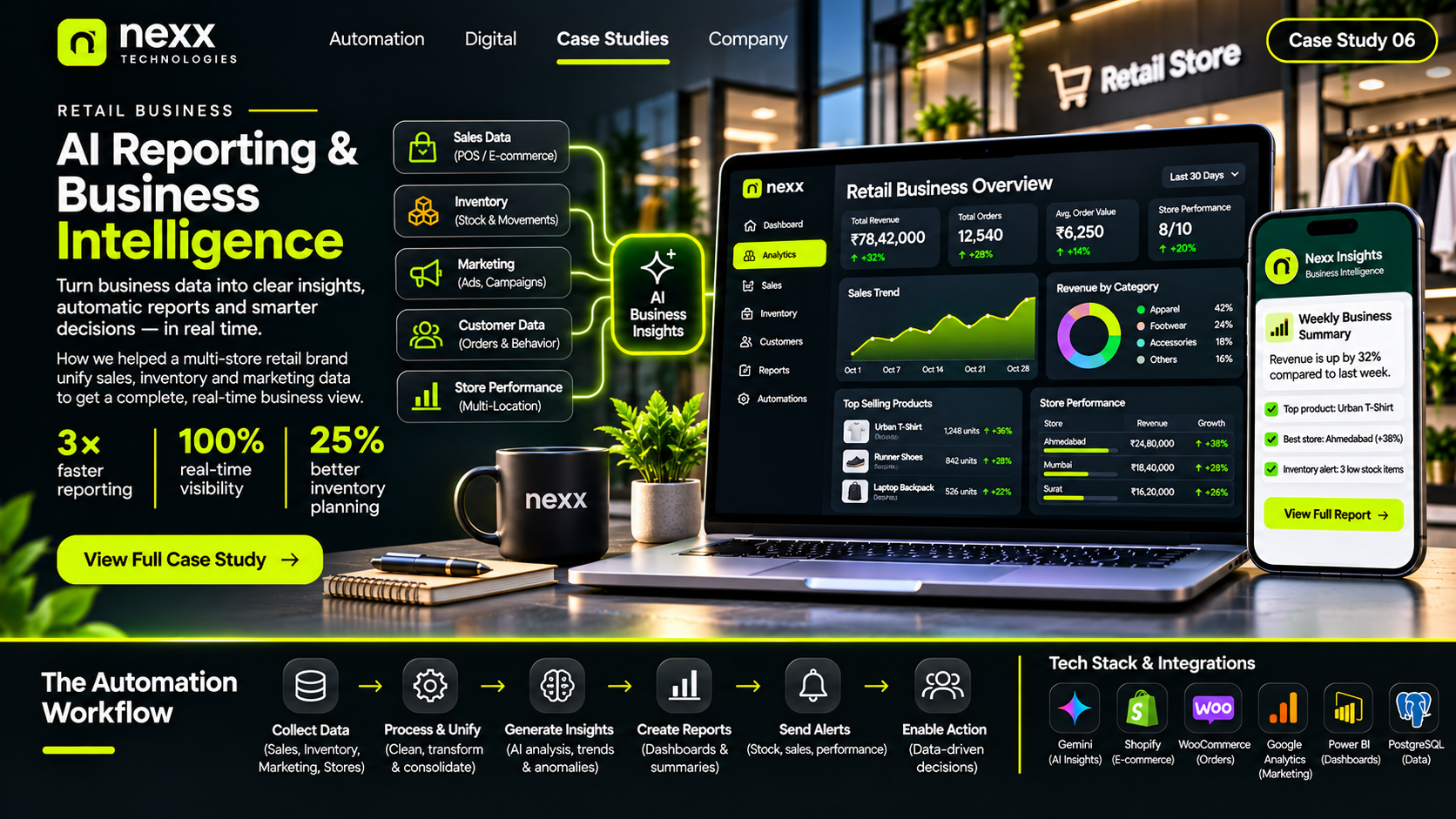
Automating daily data consolidation across 8 retail stores and e-commerce into daily 7:00 AM executive AI briefings on Slack and WhatsApp.
A retail enterprise operating 8 physical storefronts and an e-commerce website struggled with severe data fragmentation. POS registers, Google Ads, Meta Ads, and warehouse inventory databases lived in silos. Executive leadership waited until Wednesday afternoon for manual spreadsheet reports, making it impossible to address stockouts or ad waste in real time.
Core operational parameters, operational footprint, and scope of automation implementation.
Multi-store data fragmentation, delayed weekly spreadsheets, and lack of actionable inventory insights.
Automated cloud data warehouse with nightly ETL and daily AI executive synthesis briefings.
Operating without consolidated real-time intelligence meant high-selling items frequently went out of stock at physical locations while marketing campaigns continued burning ad budget on unavailable SKUs.
Executive team received weekly sales numbers 60 hours after week-end.
Stores ran out of top 10 SKUs without regional managers knowing for days.
Paid media campaigns drove traffic to online products with zero local warehouse stock.
An estimated 8-12% in missed quarterly sales due to uncoordinated stock replenishment and untargeted marketing.
Shoppers visited physical stores expecting items advertised online, only to find empty shelves.
Prior to business intelligence automation, reporting was a slow, error-prone manual Excel aggregation process.
Each store manager exported POS sales CSVs every Monday morning.
Operations analyst spent 14 hours copying data into a massive master Excel file.
Digital ad agency sent separate PDF reports on Tuesday night.
Leadership reviewed outdated slides during Wednesday afternoon meetings.
Decisions were inherently reactive, looking backward at what happened rather than acting on current sales trends.
Nexx Technologies architected an automated data pipeline consolidating POS registers, e-commerce transactions, warehouse inventory, and digital ad spend into a centralized cloud warehouse, delivering daily AI synthesis briefings every morning at 7:00 AM.
Anomaly detection identifying sudden store margin drops, predictive stockout forecasting, and natural language executive summaries.
Instant daily visibility before business opens, reducing stockouts by 42% and boosting ROAS by 28%.
Connected Shopify POS, Square POS, Google Ads API, Meta Marketing API, PostgreSQL Warehouse, and Slack.
Inventory reallocation suggestions require 1-tap confirmation from regional managers via interactive Slack buttons.
Autonomous pipeline executing every night between midnight and 7:00 AM.
Automated workers pull daily closing sales and receipts across all 8 stores and e-commerce.
Reconciles SKU identifiers, accounts for return deductions, and normalizes regional taxes.
Calculates gross profit margins, inventory turnover, store-by-store pacing, and ROAS.
AI analyst evaluates anomalies, identifies top performing products, and highlights stockout risks.
Dispatches concise executive briefing to CEO and regional leaders via Slack and WhatsApp.
Modern data stack providing real-time visibility without heavy legacy enterprise licensing.
Scalable columnar analytical database housing historical sales and SKU movements.
Automated data build pipelines executing hourly and nightly metric aggregations.
Generates concise, boardroom-ready narrative insights from tabular database outputs.
Interactive bot delivering morning digests with clickable drill-downs into store details.
Shift from stale reactive spreadsheets to proactive real-time intelligence.
Wednesday afternoon (60-hour lag).
Daily by 7:00 AM before physical stores open.
High-level store totals without SKU profitability.
Hourly SKU-level gross margin and regional velocity.
Discovered days after customers walked out empty-handed.
Predictive warning 72 hours before inventory depletion.
15% wasted ad spend promoting out-of-stock items.
Automated ad throttling when SKU inventory falls below 5 units.
Realistic operational modeling based on omnichannel retail business benchmarks.
Actionable operational intelligence ready before morning meetings.
Fewer out-of-stock incidents on top-selling retail merchandise.
Improved ad spend allocation toward in-stock high-margin SKUs.
Reclaimed from manual spreadsheet stitching and formatting.
Strict access controls protecting proprietary commercial sales data and margins.
Read-only database replication replicas preventing any write interference with live POS registers.
Automated row-count and transaction sum checksums verifying 100% data fidelity.
Encrypted REST API credentials stored in secure secret managers with daily rotation.
Automatic fallback to previous day baseline with alerting if a store internet outage delays daily sync.
Transaction ID primary key constraints preventing duplicate sales reporting.
Critical anomaly alerts sent immediately if a store reports zero sales during operating hours.
Expanding data intelligence into automated purchasing and dynamic pricing.
Direct PO generation sent to manufacturers when inventory hits reorder thresholds.
Algorithmic markdown pricing on slow-moving inventory to maximize gross margin.
Connecting in-store camera foot-traffic sensors to measure sales conversion rates.
Replace manual weekly spreadsheets with automated cloud business intelligence and daily executive briefings.